
How Capitalism Actually Began

Enclosures, Empire, and the Invention of Wage Labor
Imagine waking up tomorrow and finding that the park down the street has been fenced off.
A sign on the gate says it's now private property. The basketball court your kids played on, the field where the community held cookouts, the trees where families took photos. All of it. Off limits. Owned by someone you've never met.
Now imagine that same thing happening to the grocery store, the church parking lot, the library, the open lot where neighborhood kids practiced football. Within a few years, almost everything that used to be shared has been fenced, sold, and converted into someone else's profit.
You'd call that theft. Or worse.
But that exact process, repeated millions of times across centuries, is how capitalism actually got built. It didn't grow naturally out of human trade. It was created. Through laws, violence, and the deliberate destruction of the way ordinary people had lived for hundreds of years.
This is the story your high school history book either skipped or sanitized. Let's tell it straight.
“Capitalism didn't grow naturally out of human trade. It was created. Through laws, violence, and the destruction of the way ordinary people had lived for centuries.”
THE FOUR PHASES, AT A GLANCE
Before we dig in, here's the map. Capitalism didn't appear all at once. It developed in four overlapping phases over roughly 500 years.

Now let's walk through each phase. Pay attention to who paid the price each time the system grew.
PHASE 1: MERCHANT CAPITALISM (1400s–1600s)
The story usually starts with smart Italian bankers. Venice, Florence, Genoa. They invented double-entry bookkeeping. They created joint-stock companies. They funded long-distance trade routes. All true.
But that's only half the story. The other half is what made all that capital accumulation possible.
The Slave Trade
Between 1500 and 1850, an estimated 12.5 million Africans were forcibly transported across the Atlantic. About 10.7 million survived the journey. The rest died at sea. The wealth generated by this human trafficking didn't stay in the colonies. It flowed back to European banks, ports, insurance companies, and shipbuilders. London, Liverpool, Bristol, Nantes, and Lisbon were transformed into financial centers on the back of this trade.
Historian Sven Beckert, in his Bancroft Prize-winning book Empire of Cotton (2014), calls this period “war capitalism.” Not a metaphor. He means the system was literally built through organized violence. Slavery, military conquest, and the seizure of land and labor were not unfortunate side effects. They were the engine.
The Colonization of the Americas
When Columbus landed in 1492, the Americas were home to an estimated 60 million people. Within 150 years, roughly 90 percent of the indigenous population had died. Some from violence. Most from European diseases. The land they had stewarded for thousands of years was seized and converted into plantations, mines, and ranches.
“Capitalism's founding capital didn't fall from the sky. It was extracted from stolen land and stolen labor.”
This is the part of the story that often gets left out. Capitalism's founding capital didn't fall from the sky. It was extracted from stolen land and stolen labor. Without that foundation, the Industrial Revolution that came next would have been impossible. PHASE 2: AGRARIAN CAPITALISM (1500s–1700s)
Here's where we get to the fenced park from the opening of this article. Except in real history, it wasn't a park. It was almost everything.
For most of medieval European history, much of the land was held in common. Villagers had collective rights to graze animals, gather firewood, fish in streams, and farm certain plots. They didn't own the land in the modern sense. Neither did anyone else, exactly. The land had been used cooperatively for generations.
Then came the enclosures.
The Enclosure Movement
Starting in the 1500s and accelerating through the 1700s and 1800s, English landlords and Parliament passed thousands of enclosure acts. These laws transferred common land into private ownership. The fences went up. The gates were locked. The peasants who had lived on and worked that land for generations were pushed off.
Where did they go? They had no choice. They migrated to the cities. They had no land, no animals, no way to feed their families. The only thing they had left to sell was their labor. So they sold it. To factory owners. By the hour. For whatever wage was offered.
Anthropologist and historian Ellen Meiksins Wood, in The Origin of Capitalism (1999), argues this was the actual birth of capitalism. Not the invention of trade. Not the rise of cities. But the moment when survival itself required selling your labor for a wage. Before enclosure, most people fed themselves directly from the land. After enclosure, they could only eat if someone else hired them.
WHAT THIS REALLY MEANS Wage labor isn't natural. It had to be created. And the way it got created was by taking land away from millions of people who had never sold their labor before, and giving them no other option. That's not a footnote. That's the foundation. |

PHASE 3: INDUSTRIAL CAPITALISM (1760s–1900s)
By the late 1700s, two things had come together. First, there was capital from slavery and colonization, sitting in European banks looking for somewhere to grow. Second, there was a population of displaced peasants, now living in cities, with no choice but to work.
The match was lit. The Industrial Revolution began in Britain around 1760 and spread across Europe and North America over the next century.
The Factory System
Steam engines, mechanized looms, iron production, railroads. The technological leaps were real. But the human cost was staggering. Factory workers, including children as young as five and six, worked 12 to 16 hour days in dangerous conditions for wages that barely kept families alive. Life expectancy in industrial cities like Manchester dropped to 25 years in some neighborhoods.
In 1819, a parliamentary inquiry in England documented children working in textile mills with deformed legs from standing at machines for 14 hours a day. The factory owners' response was that any restriction on child labor would damage British competitiveness.
That argument should sound familiar. We still hear it today, just about different things.
Two Books That Defined the Era
In 1776, Scottish philosopher Adam Smith published The Wealth of Nations. This is the book that gave capitalism its theoretical defense. The invisible hand. The division of labor. The benefits of free trade. Smith was actually more nuanced than people give him credit for. He warned about monopolies, criticized the cruelty of factory work, and argued that markets needed strong moral and legal foundations. But the book became a manifesto.
In 1867, German philosopher and economist Karl Marx published Capital, Volume 1. This was capitalism's sharpest critique. Marx documented in painstaking detail how the system actually worked. Where profit really came from (the unpaid portion of workers' labor). Why crises kept happening. Why inequality kept growing. You don't have to be a Marxist to recognize that he was the first to describe the system's mechanics with that level of clarity.
These two books, written about 90 years apart, still frame how we argue about capitalism today.
PHASE 4: FINANCIAL CAPITALISM (1970s–Present)
Fast forward to the late 20th century. Something fundamental shifted.
In 1971, President Richard Nixon took the U.S. dollar off the gold standard. This ended the Bretton Woods system that had governed global finance since World War II. Within a decade, capital could move across borders almost instantly. By the 1980s, leaders like Margaret Thatcher in the UK and Ronald Reagan in the U.S. had launched a new political project. Lower taxes on the wealthy. Deregulate banks. Weaken unions. Privatize public services. Open markets globally.
This shift is often called neoliberalism, and it transformed the system again.
From Making Things to Moving Money
Industrial capitalism made profit by producing goods. Cars, steel, textiles, electronics. Workers got paid. Factories ran. Communities were built around them.
Financial capitalism makes profit increasingly from money itself. From debt, from speculation, from buying and selling companies, from interest, from derivatives, from currency trading. As of 2022, the global derivatives market was estimated at over 600 trillion dollars. To put that in perspective, the entire global economy in actual goods and services was about 100 trillion dollars.
The factories didn't disappear. They moved. To Mexico, then China, then Vietnam, then Bangladesh. Wherever labor was cheapest and regulations were weakest. The wages American workers had won through decades of union struggles got undercut by global competition that the system was specifically designed to enable.
“The factories didn't disappear. They moved. Wherever labor was cheapest and regulations were weakest.”
WHO PAID FOR EACH PHASE
Look at the pattern. At every stage of capitalism's development, somebody paid the price for the wealth that was created.
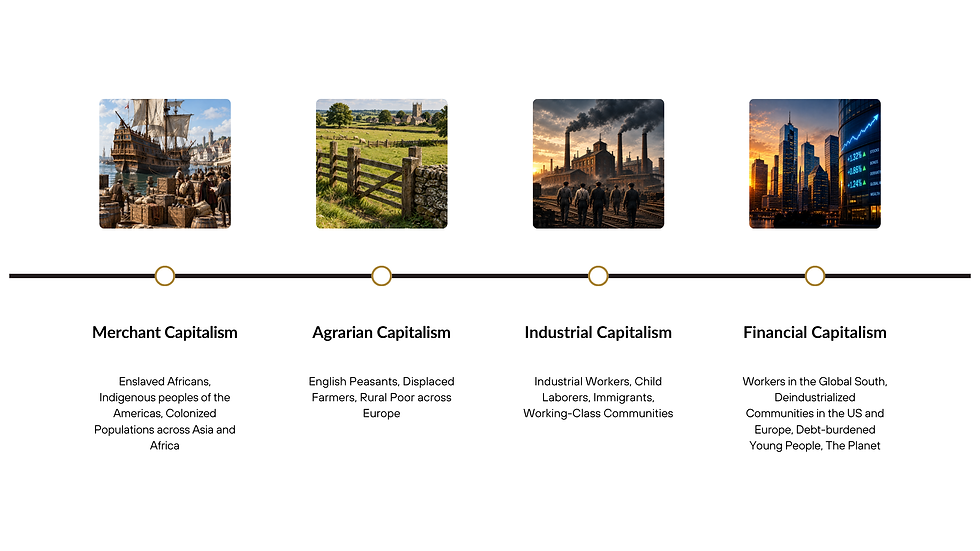
In every phase, the wealth created was real. In every phase, somebody else paid for it. That's not a glitch. That's the design.
BOTH SIDES OF THE DESK
Now let's give the strongest counter-argument an honest hearing.
Defenders of capitalism's history would say this. Yes, the early stages involved violence and exploitation. But every economic system in history has involved violence and exploitation. Feudalism. Slavery in the ancient world. The Mongol Empire. The Aztec Empire. Pretending capitalism is uniquely guilty of using force is historically naive.
They would also argue that what capitalism eventually produced, even if it started badly, has lifted more people out of poverty than any other system in human history. The Industrial Revolution was brutal, but it's also the reason your great-grandparents lived to adulthood and you have a refrigerator.
These points have weight. They deserve to be considered seriously. Pretending the picture is all dark would be just as misleading as pretending it's all light.
But here's the deeper question. If a system was built on theft and violence, and it has continued to externalize its costs onto the most vulnerable people in every era, do we just accept that as the way things have to be? Or do we ask whether we can build something different? That's the question Part 5 of this series will return to. “In every phase, the wealth created was real. In every phase, somebody else paid for it. That's not a glitch. That's the design.”
WHY THIS HISTORY MATTERS NOW
History isn't just about the past. The patterns set in motion 500 years ago are still running today.
When a corporation moves a factory from Detroit to Mexico to Bangladesh chasing lower wages, that's the same logic that drove the enclosure movement. Cut the cost of labor. Maximize profit. Leave the displaced workers to figure it out.
When a school district in a wealthy suburb has $25,000 per student per year and a school district 20 miles away has $9,000 per student, that's the same pattern of extraction and accumulation that's been running for centuries. Wealth concentrates. Costs spread.
When pesticide companies sell products they know are linked to cancer, when food companies engineer addiction into snacks marketed to kids, when oil companies fund disinformation about climate change to protect quarterly earnings, that's not new behavior. That's the same playbook that built the cotton mills of Manchester and the silver mines of Potosí.
Understanding the history is how we recognize the pattern. And recognizing the pattern is the first step toward changing it.
REFLECTION QUESTIONS
If your family had been forced off their land 200 years ago and made to sell their labor to survive, how would you tell that story to your children today?
The Industrial Revolution lifted some people out of poverty while putting others into devastating working conditions. Who decides whose lives count in that calculation?
How is the global movement of factories today similar to, or different from, the enclosure movement in England 300 years ago?
If capitalism's foundation was built through slavery and colonization, what does that mean for how we think about wealth that has been passed down through generations?
What might it mean to take honest stock of how a system actually got built, rather than the sanitized version we were taught?
TAKE IT FURTHER
Books
Empire of Cotton by Sven Beckert
The Origin of Capitalism by Ellen Meiksins Wood
Capitalism and Slavery by Eric Williams
A People's History of the United States by Howard Zinn
The Half Has Never Been Told by Edward Baptist
Watch & Listen
The 1619 Project (New York Times Magazine and Hulu series)
Documentary: 13th, directed by Ava DuVernay
Podcast: Throughline (NPR), search for episodes on capitalism, slavery, and economic history
Try This
Spend 30 minutes researching the history of the land you currently live on. Who lived there before colonization? What happened to them? Whose labor built the wealth of your city or region? You don't have to do anything dramatic with this information. Just sit with it. History becomes different when you locate yourself inside it.
So if capitalism was built through enclosure, slavery, and exploitation, why do so many smart people defend it? Are they all wrong? Or are they seeing something the critics miss?
In Part 3 of this series, we steelman the strongest pro-capitalism arguments. The poverty reduction record. The innovation track. Hayek's knowledge problem. Friedman's freedom argument. The comparative case. We give the defenders their best shot, no straw-manning, no shortcuts. Because if we're going to think clearly about the system shaping our lives, we have to understand why intelligent, thoughtful people defend it. That's coming next.
Stay with me.
— End of Part 2 —
Part 3: The Case for Capitalism

Comments